A fast cutting process is only part of a productive sheet metal operation. Between sheets, someone still needs to remove finished parts, clear the skeleton, bring in new material, and prepare the next job. A dual exchange table lets a shop overlap some of that work with cutting.
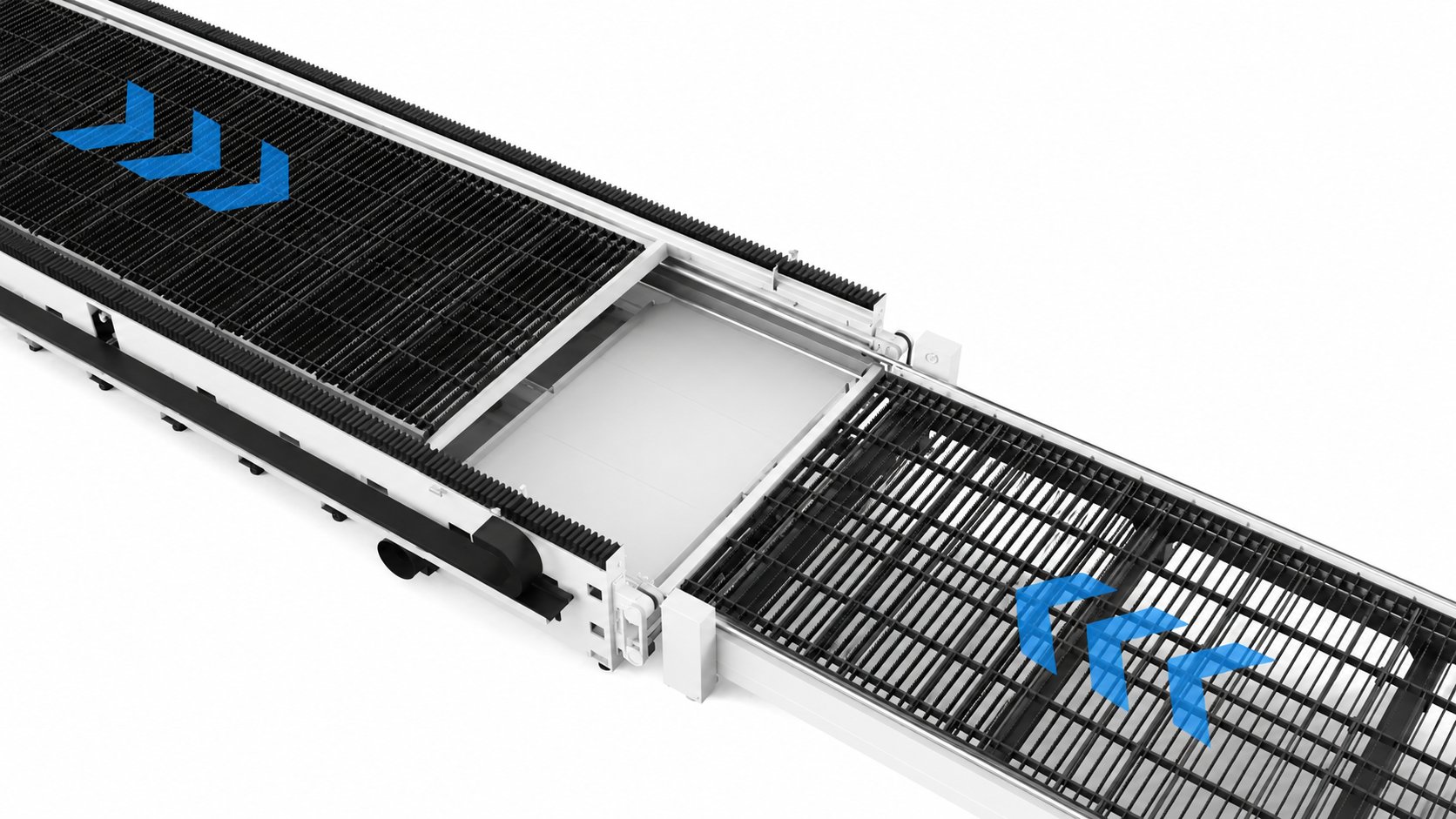
The Wavlon UltraCut Series combines an enclosed cutting cabin with two exchange tables. One table is in the cutting position while the second is available for material handling at the external loading position.
Watch the UltraCut video
Play to load YouTube. Watch on YouTube
How the dual exchange cycle works
- Cut the first sheet. The laser processes the sheet inside the enclosed cabin.
- Prepare the external table. Following the machine's operating procedures, remove completed parts and the remaining skeleton, then load the next sheet.
- Exchange the tables. Once cutting is complete and the machine is ready, the tables exchange positions.
- Begin the next job. Cutting resumes on the prepared sheet while the completed sheet becomes accessible for unloading.
The advantage is the overlap: material handling can happen during the cutting cycle instead of all of it being added after the cut. The loading area still needs clear access, suitable lifting equipment, and a trained operator.
Single table or dual exchange tables?
| Consideration | Single table | Dual exchange tables |
|---|---|---|
| Sheet changeover | Loading and unloading generally use the same table as cutting. | External handling can overlap with cutting on the other table. |
| Production pattern | Worth considering for intermittent work and lower sheet volumes. | Worth considering for repeated sheet processing and sustained production. |
| Floor planning | Plan for the machine and material access. | Also allow for table travel, loading access, and clearance. |
| Output constraint | Handling time adds to time between cutting jobs. | Handling can still delay the next cycle if the external table is not ready. |
Where the time savings come from
Consider an illustrative job with eight minutes of cutting and four minutes of unloading and loading. With sequential handling, those activities take twelve minutes before allowing for other setup steps. If handling can be completed during the eight-minute cut on a dual-table system, the repeating cycle can approach eight minutes plus the table exchange and any remaining checks.
This is a workflow example, not an UltraCut performance claim. Actual results depend on the nest, material, thickness, power, handling equipment, operator readiness, exchange time, and job setup.
If cutting finishes before unloading and loading are complete, the machine may still wait. Measuring both cutting and handling time on representative jobs is more useful than assuming that a second table will eliminate every pause.
When should a shop consider dual exchange tables?
- Repeated sheet changeovers: production involves enough sheets for handling time to become a recurring constraint.
- Available material handling: operators and lifting equipment can prepare the second table during the cut.
- A suitable shop layout: the exchange area, sheet storage, scrap removal, and finished-part staging can remain accessible.
- A balanced downstream process: sorting, bending, and other operations can keep up with the planned laser output.
Choosing an UltraCut configuration
UltraCut offers standard 3–20 kW configurations and 3015 or 4020 frame options. Choose the cutting power and working area around your material mix, sheet sizes, edge requirements, and expected workload. Table configuration alone does not determine cutting speed or part quality.
Review the UltraCut specifications, explore the sheet cutting guide, and discuss installation and operator training with our Canadian service team.
Questions to bring to your machine review
- How long do cutting and material handling each take on your typical nests?
- What sheet sizes, materials, and thicknesses will you process?
- How will you lift sheets, unload parts, and remove skeletons?
- Where will the machine, moving tables, and material staging fit?
- Which source, cutting head, controls, training, and support are included in the quotation?
Send Wavlon your production requirements to review an UltraCut configuration for your shop.
Explore more in Dual Exchange Tables or return to the Wavlon Blog.
Planning a Canadian installation?
Review our regional guide for Ontario, Montréal, Vancouver, and Calgary and quote-comparison checklist before choosing the machine and delivery scope.