
Choose a tube laser by the section, stock length, weight and finished-part handling you need. Chuck count affects the holding and transfer arrangement, but it does not by itself establish capacity, accuracy or remnant length.
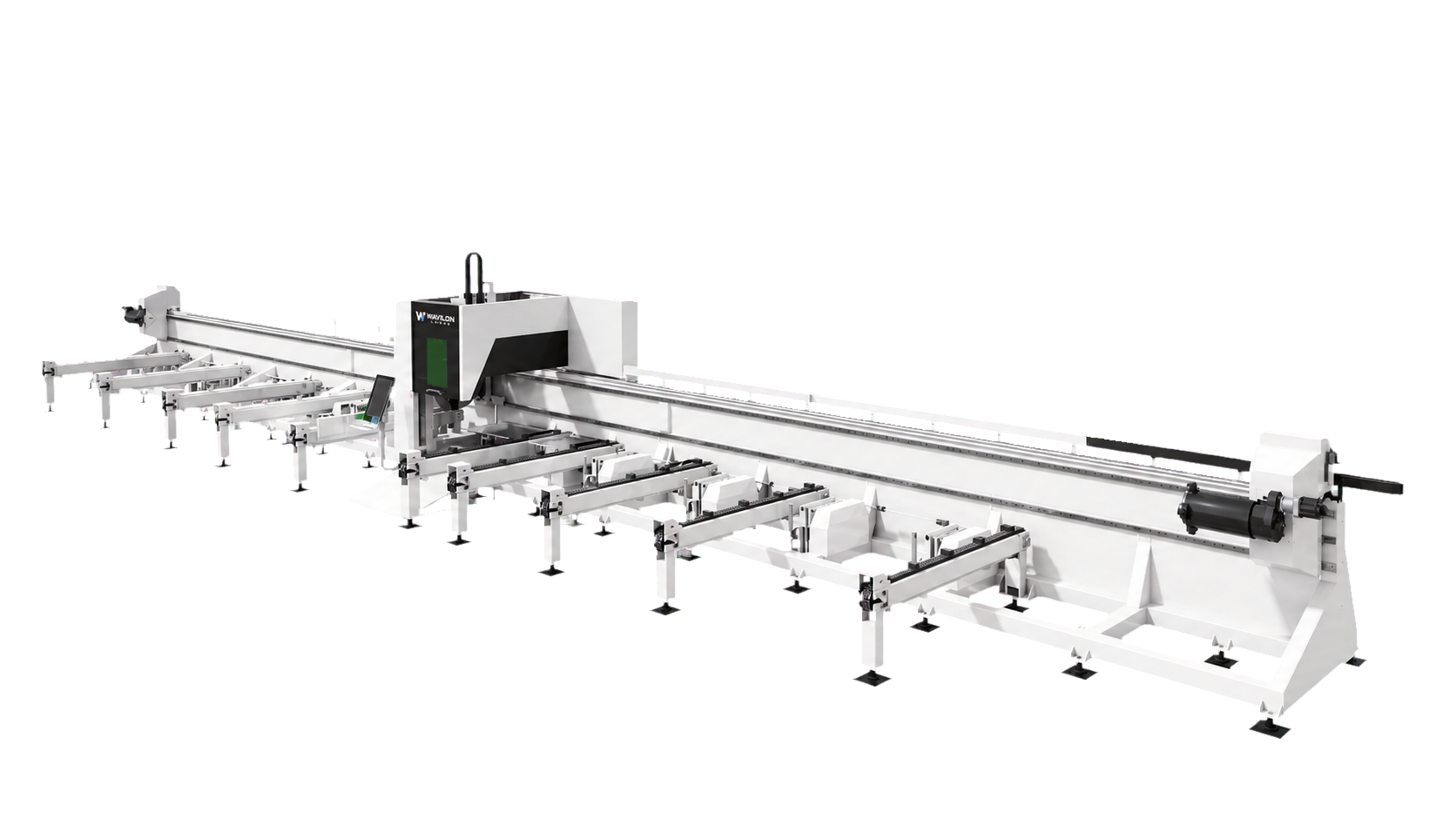
What changes when a third chuck is added?
A tube laser must hold, rotate and position stock while the cutting head follows the programmed geometry. The holding arrangement matters during cutting, stock transfer and separation of the finished part. A third chuck can provide another controlled holding point; its benefit depends on the machine design and the programmed sequence.
Do not treat three chucks as an automatic guarantee of zero remnant, zero deflection or higher accuracy on every part. Ask to see the proposed process from stock loading through part discharge. For long or heavy sections, the support and unloading arrangement deserves as much attention as the cutting motion.
Compare the current Wavlon platforms
| Selection point | TubeCut Double Chuck | TubeCut Triple Chuck |
|---|---|---|
| Published models | TDC-120, TDC-160, TDC-240, TDC-360 | TTC-360, TTC-520, TTC-680/570 |
| Bed length | 6,000 mm | 12,000 mm |
| Power across the range | 1.5-12 kW | 6-30 kW |
| Largest listed round capacity | 360 mm on TDC-360 | 680 mm on TTC-680/570 |
| Largest listed square capacity | 360 x 360 mm on TDC-360 | 570 x 570 mm on TTC-680/570 |
Source: the current Double Chuck and Triple Chuck model pages. A range is not a promise that every power and section combination is available. Confirm the chosen model's weight limit, wall-thickness application, supported profile and loading/unloading requirements in the proposal.
Define the stock and finished parts separately
List the outside dimensions, wall thickness, material grade, stock length and stock weight. For rectangular sections, provide both outside dimensions. For open or irregular profiles, send the actual section drawing and ask for an application review rather than relying on a round-tube capacity number.
Then list the longest and shortest finished parts, the location of holes or joints, and the required orientation after unloading. A machine that accepts the raw stock still needs a suitable way to support and discharge the completed part.
Include straightness and surface-condition expectations for incoming material. If your supply varies, use representative stock in the trial. Record how the operator identifies the seam or orientation where that matters to the drawing.
Watch the complete trial, including the last part
- Load normal stock. Demonstrate the proposed loading arrangement and the working space around it.
- Cut a representative assembly. Include the features that determine fit, not only a simple end cut.
- Observe holding and transfer. Ask which components support the stock and finished section at each step.
- Measure usable output. Record acceptable parts, cycle time, remaining material and any secondary work.
- Inspect the end of the bar. Ask for the actual remaining length and its cause on this nest.
Residual material depends on more than chuck count. Part geometry, grip requirements and the machine's transfer strategy can affect the result. A documented trial is more useful than an unqualified zero-waste statement.
Check the floor plan before choosing
Review the total installed footprint, including raw-material staging, loader travel, finished-part discharge, service access and the path used to bring stock to the machine. Bed length alone is not the required floor length.
If the production plan uses long, heavy sections, discuss material handling with the supplier before choosing a platform. If most orders use smaller stock, compare a suitable Double Chuck configuration against the complete workload instead of assuming that the larger platform is necessary.
Use the quote checklist to document installation and training scope. Send the stock list, representative drawings and floor plan when requesting a tube laser configuration review.
Frequently asked questions
Does a triple-chuck tube laser always leave zero remnant?
No. Remaining material depends on the machine design, grip and transfer requirements, stock and part geometry. Ask for a measured result on a representative nest.
Is round-tube capacity also the square-tube capacity?
Not always. Check the specific model. For example, the listed TTC-680/570 maximum is 680 mm round and 570 x 570 mm square; these limits are not interchangeable.