
Choose fiber laser power by testing your regular materials and thicknesses against the finished-part quality and hourly output you need. Maximum cutting thickness alone does not describe everyday production performance.
Start with the work you actually quote
A fiber laser power comparison should start with a job list. Build a small sample pack from repeat orders, a demanding current part and a realistic future application. Record the grade, thickness, quantity and finish requirement for each. Give the most common jobs the greatest weight in the decision.
For example, a shop making mostly thin-sheet brackets needs to understand small-feature quality, handling and repeatability. A shop regularly processing heavier plate needs a different test. Buying around the thickest part that might arrive once a year can leave the daily workload poorly matched to the investment.
Separate can cut from can produce acceptable parts at the required rate. Ask the supplier to identify which figures are demonstrated results, which are estimates and which depend on a particular gas, material grade or machine option.
What to compare alongside kilowatts
| Factor | What to record | Why it matters |
|---|---|---|
| Material mix | Grade, surface condition and thickness | A result on one material does not establish performance on every job. |
| Part geometry | Small holes, corners, pierces and contour length | A long straight cut is different from a nest of detailed parts. |
| Finished edge | Burr, taper, dimensional fit and coating or welding requirements | Extra finishing can offset faster cutting. |
| Assist gas | Gas type, consumption and supply assumptions | Changing gas changes the comparison. |
| Handling | Load, unload, sorting and table exchange time | Laser-on time is only part of the production cycle. |
Keep the drawing, nesting approach and acceptance criteria consistent between trials. If a supplier proposes a different process, record that change so the results remain interpretable.
Match power to the machine platform
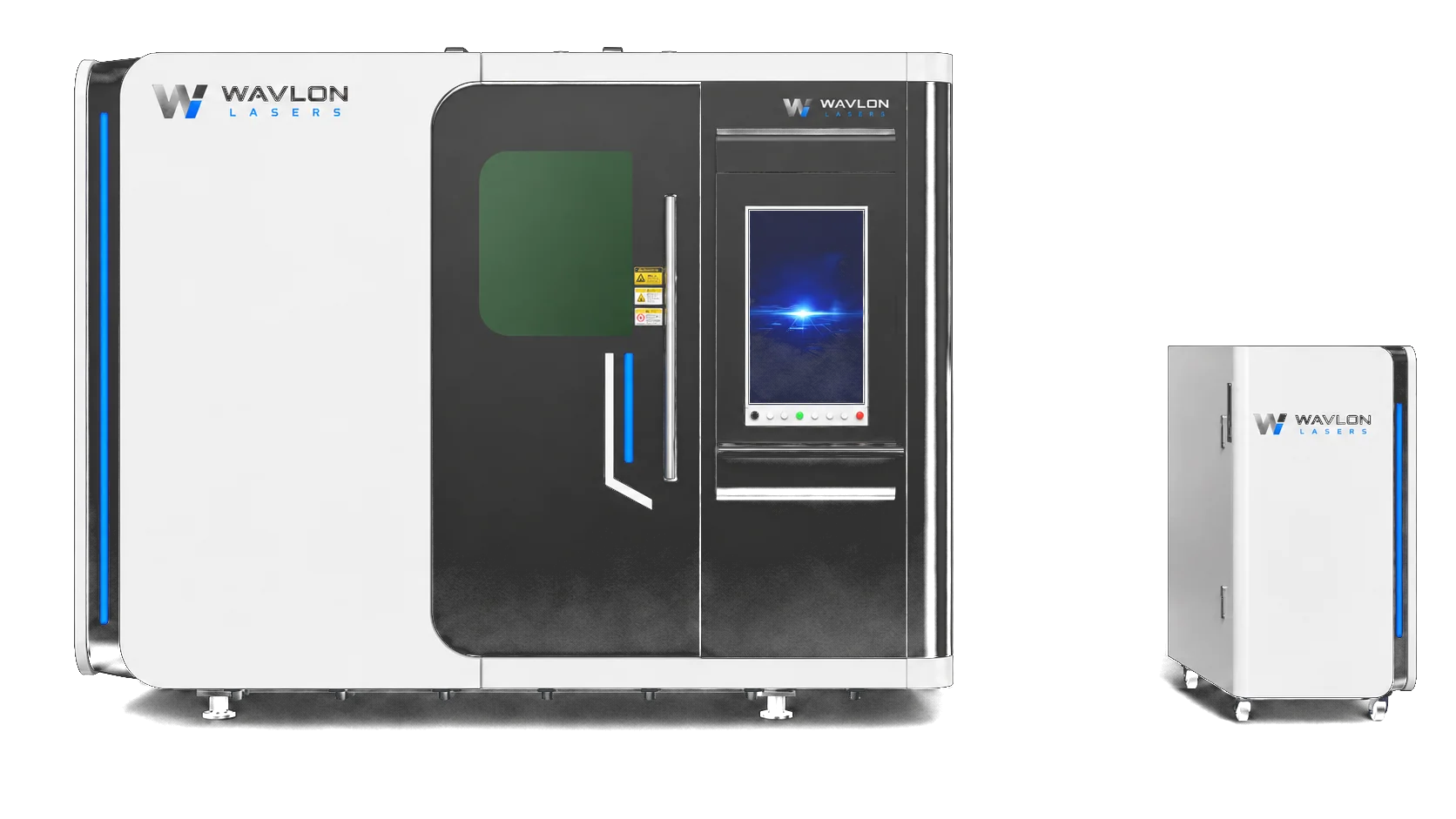
Power and machine layout are separate choices. Within Wavlon's sheet range, ProCut uses an open-bed layout, PowerCut adds a fully enclosed single-table format, and UltraCut uses dual exchange tables. Compare the available configurations on the current product pages rather than assuming that every power option fits every layout.
If the laser waits for unloading, more power alone will not remove that delay. Map the whole cycle and read our dual exchange table workflow guide before deciding where extra capacity would help. If parts queue at deburring or bending, include those operations in the discussion too.
The cutting head, source, control package, extraction and utility requirements must suit the proposed configuration. Ask for a complete equipment schedule and installation requirements with the quotation.
Request a finished-part trial
- Agree on acceptance first. Identify the dimensions, edge finish and downstream operations that determine whether a part is usable.
- Run representative drawings. Include normal production geometry, not only an easy demonstration shape.
- Record complete elapsed time. Separate programming, setup, cutting, unloading and finishing so bottlenecks are visible.
- Inspect and count acceptable parts. Compare repeat results and document rejects or rework.
- Keep the assumptions. Record material, gas, machine configuration and any operator intervention with the trial report.
A useful comparison is acceptable parts per complete production hour. If one trial cuts faster but needs more handling or finishing, ask the supplier to explain the effect on your actual schedule.
Turn the trial into a buying decision
Rank the results against your current workload, then review the future work separately. Identify what must be available on day one and what is only a possible later requirement. Ask the supplier to confirm upgrade feasibility in writing rather than treating it as automatic.
For each shortlisted configuration, collect the same operating assumptions: material yield, gas usage, electrical requirements, consumables, maintenance scope and staffing. Use the Canadian quote checklist to make the delivery and service scope comparable as well.
You do not need a universal kilowatt-to-thickness chart to start the conversation. A short, well-defined drawing pack gives a supplier a much better basis for recommending a configuration.
Frequently asked questions
Is maximum cutting thickness a production guarantee?
No. Ask for a trial on your material and drawing, with agreed edge quality, dimensions and complete cycle time. A maximum capacity figure is not a demonstrated result for every application.
Should I always buy the highest available laser power?
No. Compare acceptable output on your regular work, the complete machine configuration and handling requirements. The right choice depends on the application and the trial results.