
Request the installation pack for the exact machine configuration before arranging site work. Confirm receiving and rigging, the complete working footprint, utilities, extraction, access and the commissioning responsibilities with the relevant suppliers.
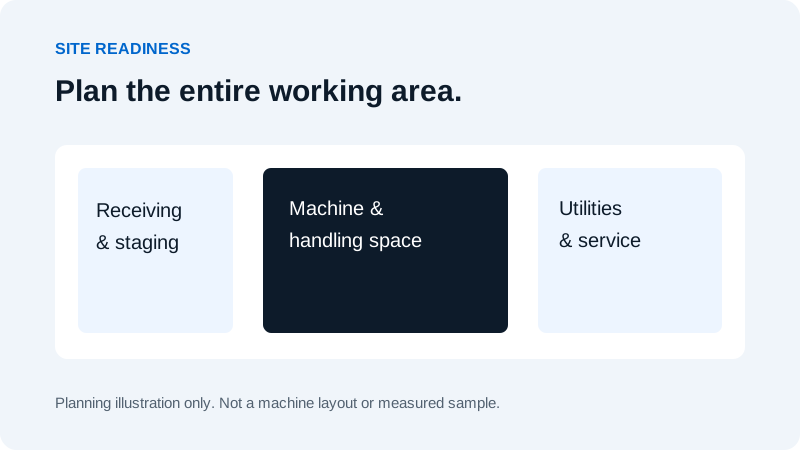
Start with the approved installation pack
A catalogue footprint is a starting point for discussion. Site preparation needs the layout and utility requirements for the equipment actually quoted, including the chiller, extraction system, loading equipment and any options. Record the revision of each installation drawing so contractors work from the same information.
Request the shipping information, rigging requirements, installed layout, service access and utility schedule before arranging delivery. Identify which responsibilities sit with the buyer, the machine supplier, the carrier and specialist contractors. Ask for open questions to be resolved before the delivery date is fixed.
This is a planning checklist. Assembly, connections, commissioning and adjustments must follow the supplied machine documentation and the responsible specialists' procedures.
Plan the route from truck to operating position
Review the actual route from the unloading point to the final position. Check door openings, turning space, overhead obstacles and any staged equipment along that route. Compare these constraints with the shipping dimensions and the planned moving method, not just the installed machine dimensions.
Have the rigging provider review machine mass, lifting information and the conditions along the route. Confirm who receives the shipment, checks the packing list and records any visible transport damage. Decide where accessories and packaging will be placed without obstructing the work area.
For a tube system, include stock staging and finished-part discharge. For a sheet system, show how material reaches the table and where parts and skeletons go after cutting. The table-handling workflow can affect the required operating space.
Assign each site-readiness item
| Area | Evidence to obtain | Who should confirm |
|---|---|---|
| Layout and floor | Approved layout, loading requirements and required clearances | Machine supplier and site facilities team |
| Receiving and rigging | Shipping data, access route and moving plan | Carrier, qualified rigging provider and buyer |
| Electrical supply | Machine-specific supply and connection requirements | Machine supplier and qualified electrical contractor |
| Assist gas and air | Quality, flow, delivery and interface requirements | Machine supplier and gas/air system provider |
| Extraction and cooling | Specified equipment, routing, access and environmental requirements | Machine supplier and appropriate installation specialists |
| Commissioning and training | Written scope, prerequisites and responsible attendees | Buyer and commissioning team |
Use the table as an action register: add an owner, due date, document reference and status to each row. “To be confirmed” is more useful than an assumed requirement that reaches the installation team too late.
Review utilities as a complete system
Confirm the electrical supply required by the quoted configuration. Do not assume a Canadian location has a particular supply or that a transformer is automatically included. The electrical contractor needs the manufacturer's requirements and the actual site conditions before determining the installation.
For assist gas or compressed air, ask what must be delivered at the machine inlet during operation. Discuss gas quality, demand and the proposed distribution arrangement with the responsible providers. Read the assist gas comparison before selecting a supply approach.
Include cooling and extraction requirements, access for servicing them, and the proposed routing through the building. Ask the appropriate specialists to review extraction for the materials and process involved. Window ventilation or an existing fan should not be assumed equivalent to the specified system.
Keep these requirements in the written scope. This guide intentionally does not give a universal voltage, cable size, gas pressure, foundation specification or clearance dimension; those values belong to the exact installation.
Prepare for commissioning and handover
Agree on who will attend commissioning and which operators need training. Arrange the agreed trial materials and approved drawing pack. Confirm whether software access, a workstation or a network connection is required for the supplied workflow, and who is responsible for making it ready.
Before the commissioning team travels, review the readiness register together. At handover, retain the installation records, operator information, agreed acceptance results and a list of unresolved items with owners. Identify the service contact and the information needed for future support.
Use the sample inspection guide to plan acceptance evidence, and the Canadian quotation checklist to clarify inclusions. Discuss the site and training scope with Wavlon service and support.
Frequently asked questions
Can I plan the installation from the machine footprint alone?
No. Include loading, unloading, stock and finished-part staging, auxiliary equipment, service access and the receiving route. Obtain the approved layout for the quoted configuration.
Do all fiber laser installations in Canada use the same electrical supply?
No. Confirm the machine requirements and actual site supply with the supplier and qualified electrical contractor. Do not infer voltage or connection details from the country alone.